Vaarta
Why I Built This
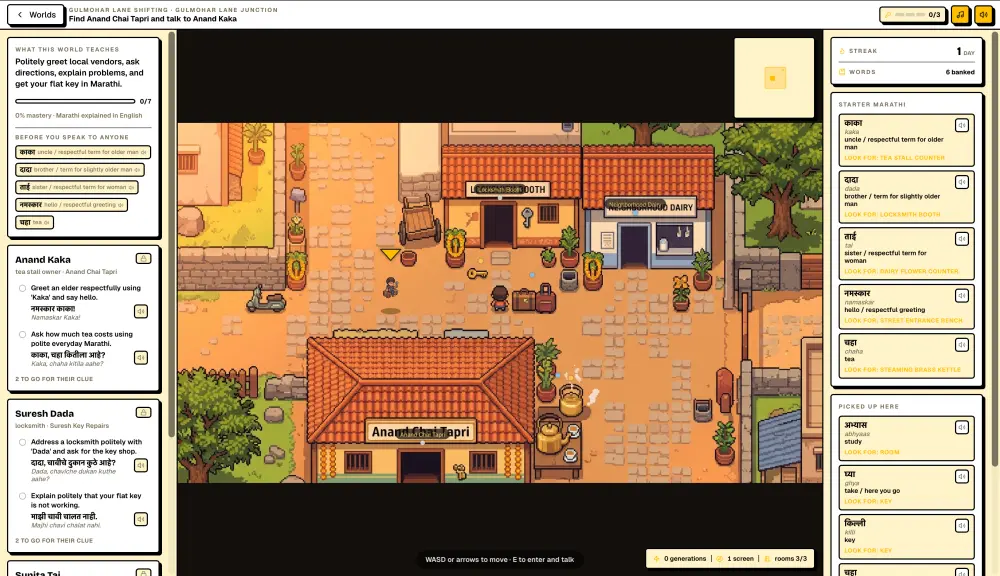
Language apps teach you to pass their own tests. You can finish an entire tree and still freeze the first time somebody answers back at a chai stall, because the app never made you choose between "kaka" and "dada", never made you ask a person for something they might refuse, and never let a conversation go sideways. Indian languages make that gap wider. Politeness is not decoration. The kinship term you pick encodes age, gender, and social distance, and choosing the wrong one is the actual mistake, not the grammar. That is close to impossible to drill with flashcards and completely natural to learn by walking into a shop and needing something from the person behind the counter. I also wanted to find out whether a generative pipeline could produce a genuinely playable world rather than a demo. Anyone can generate a nice image. Making that image walkable was the part I was not sure would work: deriving collision geometry from art no human authored, hanging a real curriculum off it, and keeping the whole thing coherent turn after turn.
Key Features
- World Authoring from a Single Prompt: Generates the lore, three NPCs with distinct social registers, and a seven-step CEFR-aligned lesson plan from one line of description. Every world ships with a Can-Do ladder running from basic greetings through negotiation and cultural nuance.
- Generative Pixel Art: Paints each scene in real time with Gemini's image models, styled to match regional Indian architecture (chai tapris, tiled roofs, coastal villas), so a generated town reads as a specific place rather than generic fantasy.
- Computer-Vision Level Design: Analyses the generated artwork to extract walkable polygons, solid obstacles, doorways, interactive hotspots, and screen-edge portals. No manual tilemap work: the collision map is derived from the painting itself.
- Conversational Tutoring: Speak or type to NPCs. A multimodal tutor evaluates grammar, script usage, vocabulary, and communicative intent on every turn, then answers in character so the correction never breaks the fiction.
- Native Voice Synthesis: Every NPC line is voiced through Sarvam AI's bulbul:v3 with native accents across six Indian languages, so learners hear the register they are being asked to produce.
- Spaced Repetition Banking: Words met mid-conversation are banked automatically and scheduled for review at increasing intervals, tying retention back to the situation the word was actually used in.