Scout
Why I Built This
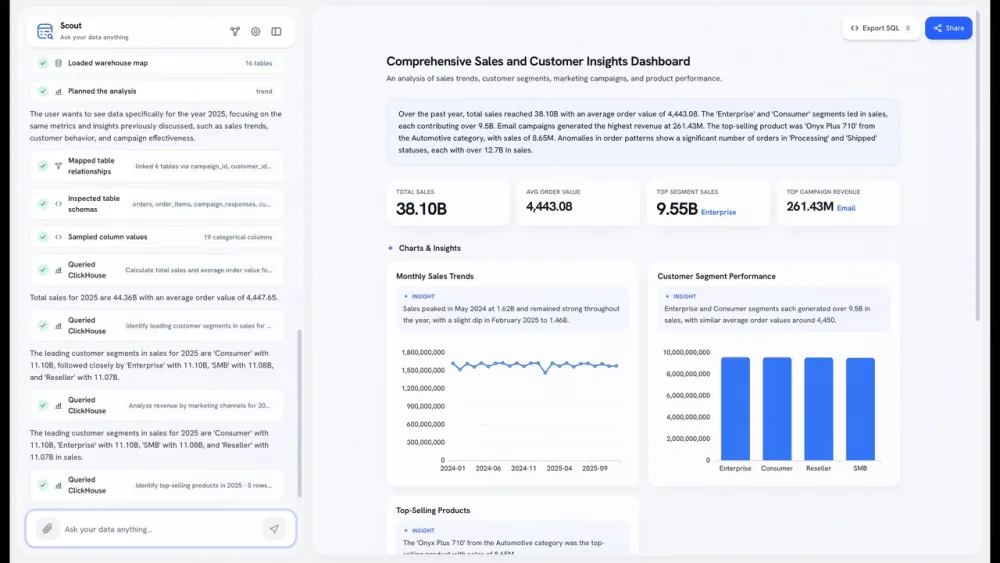
Text-to-SQL demos look great on a curated single-table schema, but they break down when pointed at real production warehouses. The core challenge in data analytics was never writing basic SQL: it was resolving table joins across massive datasets. Because production data warehouses rarely declare foreign keys, traditional LLM approaches guess relationships based on column names alone, producing confidently incorrect numbers that are hard to catch. I built Scout around the insight that the truth is already in the data: if orders.customer_id joins with customers.customer_id, their values actually overlap in live tables. By probing live data to verify join edges before retrieval, Scout treats the schema as a verified knowledge graph. I wanted to build an analytics system I would actually trust: one that links to your own warehouse, queries ridiculously huge, billion-row databases in seconds, streams its reasoning transparently at every phase, and operates with strict read-only safety.
Key Features
- Built for Billion-Row Performance: All heavy aggregations and data computations are pushed directly down into ClickHouse, allowing Scout to query ridiculously huge, billion-row datasets and render interactive dashboards in seconds while only reading small aggregated result sets.
- Plain-English to Interactive Dashboards: Ask open-ended questions like 'Where is delinquency rising?' or 'Which product is declining?' to receive executive summaries, hero metrics, interactive ECharts visualizations, detail tables, and actionable recommendations in a single pass.
- Data-Verified Graph RAG Engine: Real analytical warehouses rarely declare foreign keys. Scout infers candidate join keys and verifies every edge against live data using semi-join probes to drop phantom joins so multi-table queries join accurately.
- Live Transparent Reasoning Pipeline: Executes a 6-phase reasoning workflow (DISCOVER → PLAN → RELATE → INSPECT → ANALYZE → SYNTHESIZE) and streams progress chips over NDJSON in real time, letting users audit warehouse mapping, schema graph traversal, and SQL queries as they run.
- Interactive Graph RAG Lab: Features a built-in workbench (/graph) to visualize the schema graph, inspect join key overlap metrics, test retrieval paths, and manually declare aliased relationships that automatic inference cannot detect.
- Read-Only & Production Safe: Enforces safety with a strict SQL statement allowlist (SELECT, DESCRIBE, SHOW, EXPLAIN only), ClickHouse session-level readonly=2, and query timeouts to guarantee zero data mutation and prevent runaway resource usage.
- Bring Your Own Warehouse & File Attachment: Credentials are encrypted server-side with AES-256-GCM into an httpOnly cookie so no connection state is stored. Users can also attach CSV, Excel, or JSON files to dynamically load them as typed MergeTree tables.